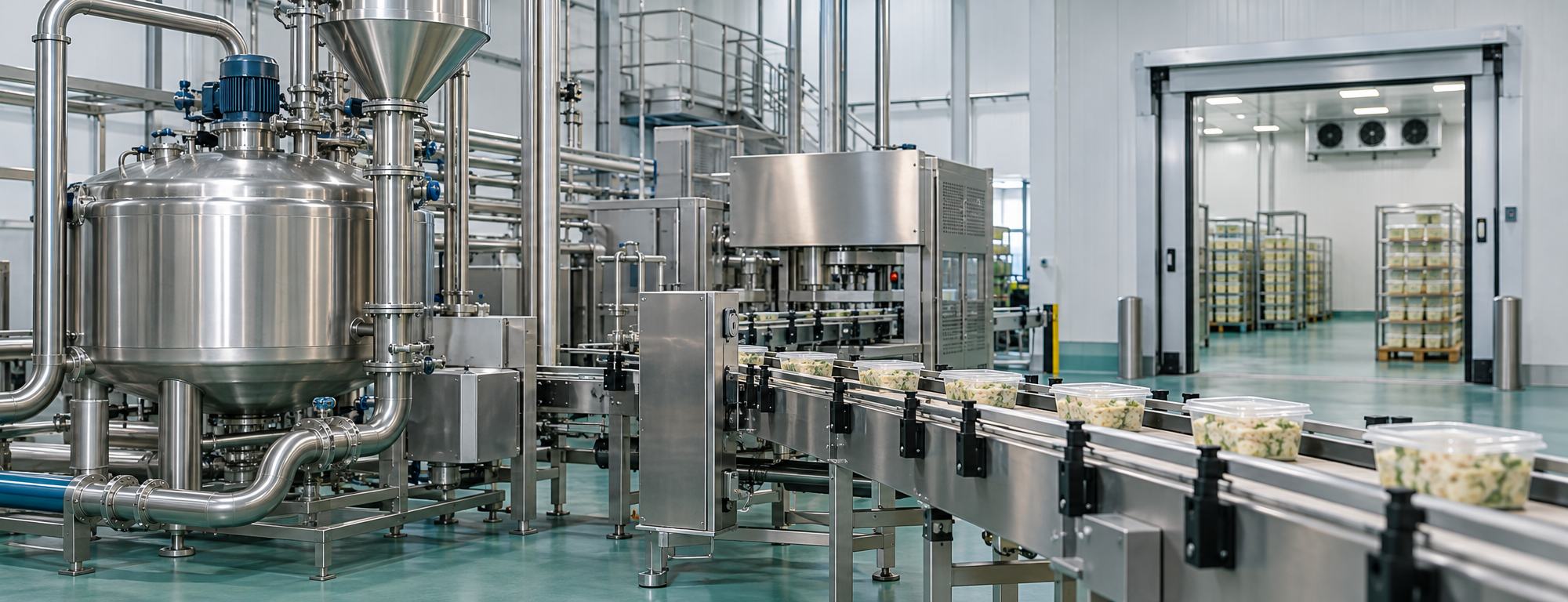
Food processing • Electrical loads across the production system
Map the process boundary before comparing electricity supply
Food processing is not one electrical load. A facility that dries an ingredient, one that freezes a finished product and one that mixes and packages ambient goods can have very different energy systems. The Department of Energy describes food manufacturing across drying, refrigeration, freezing, baking and steam-based operations. A useful procurement brief therefore begins with the actual process route, not a generic “food factory” consumption assumption. DOE food and beverage manufacturing overview.
Draw a simple boundary around the utility account being reviewed. Does it cover processing only, or also raw-material storage, a separate warehouse, treatment equipment and administrative space? If several businesses occupy the property, establish which activities sit behind the relevant meter. That boundary determines what the electricity history represents and which future changes belong in the supply discussion.
Prepare a process-specific energy inquiry
Connect the facility’s utility account with its operating scope before continuing to the business form.
Check Commercial Energy RatesUse a process-and-utilities map instead of an equipment shopping list
Start at receiving and follow the product through preparation, transformation, preservation, packing and dispatch. Mark the stages present in your own plant; a facility does not need every stage below. Then identify the utilities supplying each stage. This reveals where an apparently simple production change may affect more than the machine being purchased.
| Part of the process | Electrical questions to investigate | Information that purchasing needs |
|---|---|---|
| Receiving and holding ingredients | Are ingredients stored at ambient conditions or in temperature-controlled rooms? Which conveyors, pumps or transfer systems are part of the account? | The holding arrangements, normal receiving pattern and any planned change in storage capacity. |
| Transforming the product | Which steps use electric drives or electric heat, and which depend on separately fueled heating or steam? | A process description that distinguishes fuel inputs rather than treating every utility cost as electricity. |
| Preserving and storing output | Does the operation include chilling, freezing, drying or another preservation route? What must remain operating between production runs? | The installed systems and the expected relationship between production and storage periods. |
| Packing and moving finished goods | Which lines, air systems, wrapping equipment and material-handling activities operate after processing stops? | The end-to-end operating window, including finishing and dispatch activity. |
| Supporting the site | Which shared pumps, fans, water systems or other services support multiple lines? | The common loads that cannot be attributed to a single product without further measurement. |
Keep thermal energy and electricity in separate columns
Process heat may come from burners, electric heaters or another arrangement. DOE’s process-heat explanation makes that distinction explicit. Record the actual source for each heating step and note the electrical equipment that supports it. A change to a thermal process can alter the electricity pattern, but its entire energy requirement should not automatically be counted as an electric load. DOE process heat basics.
For example, a project team evaluating a new heating method should distinguish existing fuel consumption, proposed electrical input and any systems being retired. If a supplier is shown only the old electric bills, it may receive no indication of the intended change. Conversely, keeping an existing thermal arrangement does not mean associated pumps, fans or controls disappear from the electricity account. These are questions for the facility’s engineering records, not assumptions to resolve from an industry label.

Investigate common services without losing the production context
A shared compressor, pumping arrangement or refrigeration system can support several product lines. Looking only at the motor on a newly purchased machine may miss that wider relationship. DOE’s Better Plants material treats motors and drives as systems and offers resources for compressed-air assessment. Use those resources to guide an appropriately qualified facilities review, while giving procurement a clear account of the systems actually installed. Motor-system resources · Compressed-air resources.
Useful operating questions include whether a common system runs for one line or for the whole plant, what continues during a production pause, and whether a planned expansion adds an independent system or draws on an existing one. Obtain answers from the people responsible for operating the site. A tariff comparison cannot determine those physical relationships, and an efficiency investigation should not be presented as a guaranteed supply-price saving.
Explain output and shutdowns in a way that preserves comparability
Choose production measures that reflect the plant’s product mix. A tonne of incoming material, a tonne of finished output and a count of retail packages describe different things. If yield, moisture removal or packaging format changes, the relationship between electricity and any one output measure may also change. Keep those definitions with the usage records so the next reviewer understands the comparison.
Next, distinguish a line stop from a site shutdown. A line may be idle while storage, supporting utilities or finishing work continues. Identify the actual arrangement rather than assigning zero consumption to every nonproduction hour. Where sanitation or a scheduled maintenance period forms a distinct operating phase, describe it separately. This is a request for an accurate operating record, not advice to change food-safety controls or required process settings.
A project note that engineering and purchasing can both use
For each material change, record the affected process stage, the equipment being added or removed, the intended commissioning sequence and the expected production pattern after startup. Identify assumptions that remain provisional. That single project note helps prevent a supplier proposal from relying on the current plant while the operations team is budgeting for a substantially different one.
Choose the right level of industry detail
This overview connects the plant’s systems; a more specific guide should address the process itself. A bakery needs to examine its bake cycle and oven arrangement. Dairy processing and meat and poultry processing require their own equipment and production descriptions. Do not transfer another food manufacturer’s usage pattern to your site merely because both businesses manufacture food.

Resolve these procurement issues before accepting a proposal
Which production assumptions sit behind the offer?
Ask what usage history, expected volume and operating profile the supplier has used, and how the written agreement handles departures from those assumptions. If a new product line or conversion is planned, identify it during the proposal process rather than relying on a later informal conversation.
Are quoted supply costs being confused with the facility’s entire energy budget?
Keep separately billed fuels, electricity delivery costs and the proposed supply component identifiable. Review included and passed-through charges in writing. The purchasing team should be able to explain which part of the budget the proposal changes and which physical or regulated costs remain outside it.
Does the location permit the supply arrangement being discussed?
Check the actual distribution utility and business account through the location guides, then verify current program rules and supplier acceptance for the premises. A plant’s industry classification does not override municipal utility arrangements, capped programs or other account restrictions.
Who should review the operational assumptions?
Include the people responsible for production, engineering and the commercial agreement. Production can explain the intended throughput; engineering can identify the utility systems; the contracting representative can reconcile those assumptions with written terms. Keeping their roles connected makes the inquiry more informative without treating an initial request as enrollment authorization.
Bring the facility boundary and process plan together
Use a current utility bill and a concise description of the food plant’s actual systems to begin.
Prepare a Food-Processing Energy InquirySources reviewed October 29, 2026. Examples describe questions to investigate at the actual facility; no process arrangement, usage level, customer relationship, supplier offer or saving is assumed. Images illustrate electricity topics rather than a named processing plant.